bWIN EEG 001: a matched EEG forecasting release
24 measured samples in; 64 future samples out. One task, explicit splits, reusable weights.
bWIN EEG 001 turns a short segment of 64-channel EEG into a
forecast of the next 512 milliseconds. It is a task-specific release from WIN,
registered as win-002, with artifact
win-002-eeg-model. Its relation to SC-WBD is tested on a shared EEG
forecasting task; the earlier multimodal checkpoints retain their own scope.
Checkpoint, source wheel and model card · Full comparative report · Lessons from the released models
The task every measured row receives
| Contract | Locked value |
|---|---|
| Signal | EEGMMIDB, canonical 64-channel montage, resampled to 125 Hz |
| Observed context | 24 samples, or 192 ms |
| Forecast | 64 future samples, or 512 ms, for every channel |
| Primary split | 67 training, 17 validation and 25 test participants |
| Historical common subset | Five participants held out by both SC-WBD-003 and SC-WBD-004 |
| New neural comparators | EEGNet-style and ShallowConvNet-style forecasting adaptations, trained from random initialization |
Horizon correction. The historical setting
data.window = 64 denotes the future target length. Subtracting the
24 context samples from it would incorrectly produce a 40-sample forecast.
This comparison evaluates 24 context samples followed by 64 future samples.
Historical scores elsewhere on this site keep their own evaluation labels.
The cached signal uses offline zero-phase filtering, whole-recording resampling, robust scaling and rejection statistics. The model receives context only, but this preprocessing can use later samples in the same recording. These measurements describe forecasting on that processed signal, not an end-to-end causal raw-EEG stream.
The fitting budget was amended from a 10-epoch community pilot to 50 epochs for every newly trained neural model. The pilot had already evaluated test data; although the 50-epoch decision preceded inspection of those pilot scores, this release does not call the final test previously untouched. The checkpoint selection criterion within each final fit remains validation MSE.
New measurements on the matched task
bWIN improves on zero prediction on the 25-person test panel. Its mean-participant R² is 0.065248; however, AR16, VAR4 and both freshly trained community adapters have lower average MSE and Gaussian NLL. The EEGNet adaptation's advantage is supported by paired participant intervals for both error and density. This release establishes a working mechanistic forecasting artifact, with no claim that it is the best predictor.
| Primary model, 25 people | MSE ↓ | Gaussian NLL ↓ | Mean-person R² ↑ |
|---|---|---|---|
| bWIN | 4.497662 | 2.169866 | 0.065248 |
| EEGNet forecast adapter | 4.365396 | 2.155938 | 0.095086 |
| ShallowConvNet forecast adapter | 4.424024 | 2.162101 | 0.084709 |
| AR16 | 4.490870 | 2.154648 | 0.082119 |
| VAR4 | 4.443725 | 2.153318 | 0.085790 |
| Zero | 4.953392 | 2.219462 | -0.005914 |
| Persistence | 9.016314 | 2.489331 | -0.828763 |
| Context mean | 7.246531 | 2.400386 | -0.435034 |
bWIN minus EEGNet MSE is +0.132266, with paired 95% interval [+0.063973, +0.203103]; negative would favor bWIN. Against zero, the difference is −0.455730 [−0.724394, −0.215209]. The primary MSE intervals against AR16, VAR4 and ShallowConvNet cross zero; their lower means are not decisive separation. VAR4's NLL advantage does have an interval excluding zero. The full report gives every comparison, using 2,000 paired participant resamples. These pointwise intervals do not cover seed or hyperparameter uncertainty and are not adjusted for multiple comparisons.
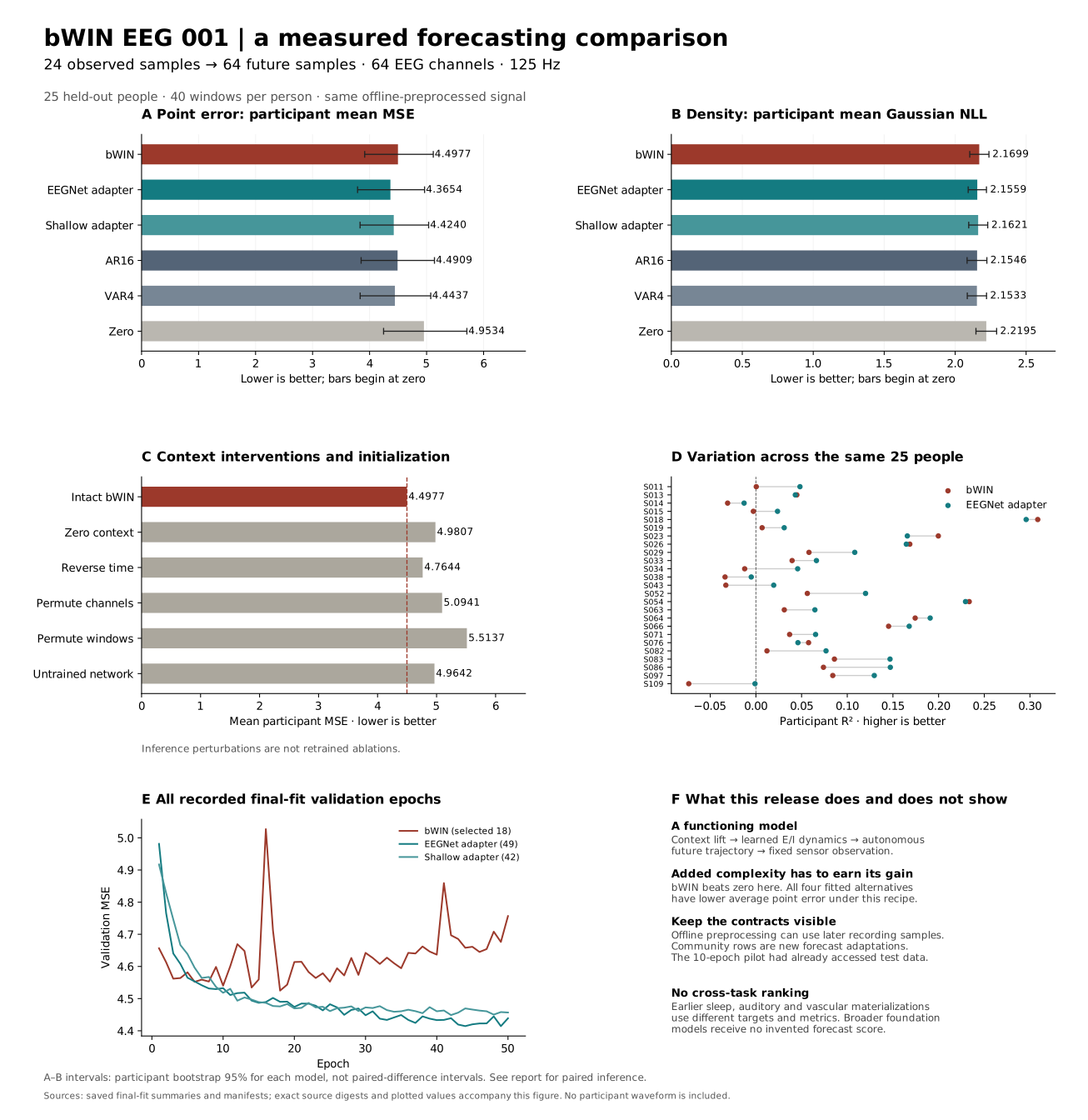
The bWIN model has 329,472 network parameters plus 64 fitted horizon-variance values. It selected epoch 18 of 50; EEGNet and ShallowConvNet selected 49 and 42. All eight bWIN tensor groups have nonzero recorded data gradients and selected weight movement. That proves exercised learning, not recovered physiological parameters. The figure exposes bWIN's later validation instability. These models are not capacity matched, and bWIN batches within people while the community adapters mix people within batches.
A fresh comparison with SC-WBD-003 and 004
This panel uses only S026, S033, S034, S066 and S082, held out by both historical checkpoints. It is distinct from their original full-holdout scores.
| Same five people | MSE ↓ | Gaussian NLL ↓ | Mean-person R² ↑ |
|---|---|---|---|
| bWIN | 4.143927 | 2.127739 | 0.070627 |
| SC-WBD-003 | 3.913787 | 1.990275 | 0.117216 |
| SC-WBD-004 | 4.034619 | 2.043563 | 0.102808 |
bWIN minus SC-WBD-003 MSE is +0.230141 [+0.053943, +0.420776]; minus SC-WBD-004 is +0.109308 [+0.026649, +0.204017]. Both historical checkpoints perform better on this narrow sample. Five people and different original training regimes do not support a universal model ranking. Historical inference retains native heteroscedastic variance; the new models fit horizon-only variance on training residuals. Checkpoint-specific posterior normalization and the 004 individualizer are preserved; neither historical checkpoint is retrained.
Context controls
Mean-participant MSE rises from 4.497662 for intact bWIN to 4.980723 with zero context, 4.764398 after time reversal, 5.094081 after channel permutation, 5.513663 after cross-window permutation and 4.964215 at untrained initialization. All twelve registered control directions agree. Those hypotheses establish basic predictive/context use; they do not claim bWIN wins against the trained models. Input interventions are not refitted capacity-matched pathway ablations.
What the community comparison means
EEGNet and ShallowConvNet supply established EEG classification architectures. Our forecast adapters replace their classifiers with multichannel linear outputs and shorten pooling to fit the available context. EEGNet retains temporal, depthwise spatial and separable convolutions; ShallowConvNet retains temporal and spatial filtering followed by square, mean and log operations. Each receives exactly the same observed samples. These are newly trained adaptations, not the authors' pretrained models or a reproduction of their classification experiments. Pinned architecture reference.
The following models answer related questions and have different input or training contracts. They provide context for the release, with no numerical rank assigned on this forecasting task.
| Community model | Established task and available implementation | Why it is contextual here |
|---|---|---|
| LaBraM | Masked EEG representations for downstream decoding. The official repository provides a base checkpoint and tokenizer, with MIT-licensed code. | The documented pipeline uses 200 Hz input and one-second channel patches. Our 192 ms context is shorter than one patch. Padding it into a token would measure a new adapter with a severe input mismatch. The pretraining collection also requires an overlap audit before claims of unseen participants. |
| BENDR | Contrastive EEG representation learning. Official encoder/contextualizer weights are linked in the pretrained release. | A representation encoder needs a newly fitted forecast head and its own sampling/montage policy. The official downstream protocol includes EEGMMIDB; a downstream-fitted checkpoint cannot be assumed to have excluded this benchmark's test people. Redistribution terms were not established in this audit. |
| BrainBERT | Self-supervised intracranial representations; the official repository links trained weights and Brain Treebank data. | The expected input is Laplacian-referenced intracranial recordings, with spectral preprocessing. Scalp EEG and a 192 ms context require a different adapter and a new test. Redistribution terms were not established here. |
| The Virtual Brain | A brain-network simulation platform with biologically structured connectivity, released as GPLv3 software. | A simulator needs an observation map, state-estimation and fitting protocol before it becomes this conditional EEG forecaster. Its simulation capabilities cannot be ranked using a decoding accuracy from a different task. |
Source details: LaBraM preprocessing, LaBraM patches, LaBraM license, BENDR downstream datasets, BrainBERT input and weights, TVB distribution and license. Checked September 5, 2026.
What these experiments teach us
The transferable pattern is a named use, an explicit input contract, selected mechanisms, fitted uncertainty, held people, alternatives and a reloadable artifact. Each experiment below tests a specific use of WIN’s own mechanisms and records where it helped or failed.
| Earlier WIN integration | Measured lesson | Next practical step |
|---|---|---|
| Audio → MEG recurrent state | Selected R² −0.001035; all recurrent arms lose to zero. The prior small MLP scores +0.000337. | Improve optimization and capacity controls before claiming recurrence adds predictive value. |
| Sleep spectra and neural/temporal features | Simple band-power balanced accuracy 0.690114 beats integrated 0.668703 on four test people. | Keep the simple baseline, investigate N1 errors, and evaluate external participants. |
| Task → calibrated BOLD | Mechanistic R² 0.063090; canonical HRF 0.046543; ten-second shifted drive 0.095520. | Resolve timing specificity before interpreting fitted physiology. Separate fitting does not solve joint shared-state interference. |
| Past → future EEG | bWIN beats zero, but fitted alternatives and both historical checkpoints on their common subset perform better. | Use those alternatives as practical references while testing which dynamics improve stable held-out prediction. |
These tasks use different targets and metrics. No cross-task average or single jointly trained multimodal checkpoint is implied. Gradients and parameter movement establish exercised computation; they do not identify a biological mechanism. Building more mechanisms remains useful engineering, while each predictive claim must earn its own evidence.
Use the checkpoint
Download bWIN EEG 001 and follow its model card to install the supplied source wheel and pinned dependencies. Inference needs no training dataset or predecessor repository.
Public revision
d86f3c585ac67b12add3820c60ceabf5e3f6bbde
was downloaded independently: all 47 payload file hashes matched. Installing
its wheel and running isolated Python outside the repository reproduced the
synthetic mean and variance with maximum absolute error 0.0, without raw data.
Download the verification receipt.
Supply a finite floating context array shaped
(batch, 24, 64) at 125 Hz, already preprocessed and ordered exactly
as the saved channel list. Output mean is (batch, 64, 64);
variance is (1, 64, 1) in the same scaled units. The geometry is a
constructed template, not participant digitization. Inference does not perform
raw EEG preprocessing.
The package includes selected weights, geometry, source fingerprints, a synthetic replay example, the comparative report and this figure. The example contains no participant EEG. Source and dependency mismatches are refused. Read the inference contract and protocol history before using the results.